

Alzheimer's & Dementia Care in West Sussex: Symptoms, Stages & Care Options
Understanding the early signs of Alzheimer's disease, how dementia progresses, and the care and support available for families across West Sussex.

Alzheimer's & Dementia Care in West Sussex: Understanding Symptoms, Stages and Care Options
When someone close to you begins forgetting recent conversations, becoming confused in familiar surroundings or finding everyday tasks more difficult, it is understandable to feel concerned.Families may wonder whether these changes are simply part of getting older, the result of another health issue, or possible Alzheimer's symptoms.
Alzheimer's disease is the most common cause of dementia, but memory problems do not automatically mean that someone has Alzheimer's disease.
Dementia is an umbrella term describing a range of symptoms associated with a decline in cognitive function, while Alzheimer's is a specific disease that causes dementia. Other conditions, medicines and health problems can sometimes cause or worsen similar symptoms, which is why appropriate medical assessment is important.
For families looking for Alzheimer's care in West Sussex, understanding what may happen as the condition progresses can also make it easier to think about the future.
Care may range from family support and professional help at home through to respite, residential care or Alzheimer's nursing care, depending on the person's individual circumstances.
At Homelands Nursing Home, part of Medicrest Group, in Cowfold, West Sussex, we understand that considering professional care can be an emotional and highly personal decision.
This guide explains Alzheimer's disease, its possible symptoms and stages, and the different care options families may wish to consider.
Important: New, persistent or worsening problems with memory, thinking, communication, behaviour or everyday functioning should be discussed with an appropriate healthcare professional.
This article provides general information and is not a substitute for individual medical assessment or advice.
What Is Alzheimer's Disease?
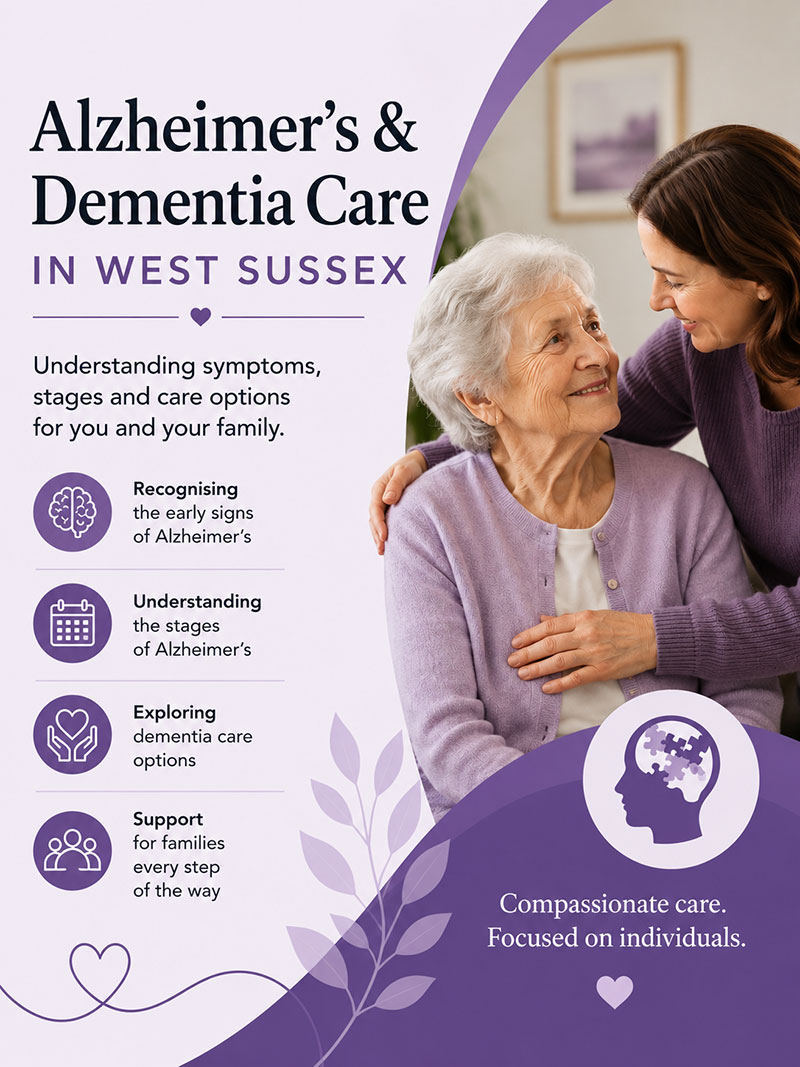
Alzheimer's disease is a progressive brain condition and the most common cause of dementia.
Dementia itself is not a single disease; it is a term used to describe symptoms affecting abilities such as memory, thinking, language, problem-solving and behaviour.
This distinction is important.
Someone can have dementia caused by Alzheimer's disease, but dementia can also have other causes.
These include vascular dementia, dementia with Lewy bodies and frontotemporal dementia, as well as mixed forms where more than one disease contributes to a person's symptoms.
Alzheimer's disease affects the brain progressively. Symptoms are often mild initially and generally become more significant over time, although how Alzheimer's disease progresses varies considerably between individuals.
This individual variation is one reason why good Alzheimer's care should focus on the person rather than simply their diagnosis.
What Are the Early Symptoms of Alzheimer's Disease?
Early Alzheimer's symptoms commonly include increasing difficulty with recent memory, alongside possible changes in thinking, organisation, communication, orientation and everyday functioning. However, no single symptom confirms Alzheimer's disease.
According to the NHS, memory lapses are a common feature during the early stages of Alzheimer's disease, while Alzheimer's Society highlights potential difficulties involving memory, planning, concentration, language, orientation and mood.
Possible signs an elderly parent may have Alzheimer's can include:
. Repeatedly forgetting recent conversations or events
. Asking the same questions without remembering the previous answer
. Regularly misplacing belongings
. Finding familiar tasks increasingly difficult
. Struggling to organise appointments, bills or other activities
. Difficulty finding words or following conversations
. Becoming confused about dates, times or familiar places
. Finding decisions or problem-solving more difficult
. Changes in confidence, mood, motivation or social engagement
The important consideration is often whether there has been a persistent change from the person's usual abilities and whether those changes are beginning to affect everyday life.
Memory Loss Does Not Always Mean Alzheimer's Disease
Occasionally forgetting someone's name or walking into a room and temporarily forgetting why is not, by itself, evidence of Alzheimer's disease.
Memory, concentration and behaviour can be affected by numerous factors and health conditions.
The NHS also notes that infections, stroke, delirium and certain medicines can contribute to worsening dementia symptoms.
Rather than attempting to diagnose Alzheimer's at home, families who notice persistent or worsening cognitive or behavioural changes should encourage the person to seek appropriate medical advice.
A GP can consider the wider picture and determine whether further assessment is appropriate.
What Are the Stages of Alzheimer's Disease?
Alzheimer's disease is commonly described in broad early, middle and later stages. These stages help families understand how support needs may change, but they are a guide rather than a fixed timetable.
Dementia does not progress identically in every person.
Symptoms may overlap between stages, appear in different sequences or affect particular abilities more than others.
Early-Stage Alzheimer's Disease
During the earlier stage, many people remain substantially independent.
Someone may still be able to manage their personal care, social activities and familiar routines but experience increasing difficulty with recent memory, complex decisions, organisation or finding words.
This can be an important time to discuss future preferences while the individual is able to participate fully in decisions.
Practical support might involve calendars, reminder systems, organised medication, clearer routines or assistance with more complicated tasks.
The objective should generally be to support independence rather than unnecessarily remove it.
Middle-Stage Alzheimer's Disease
As Alzheimer's progresses, the person may need more regular assistance.
Memory and communication difficulties can become more pronounced. Someone may require reminders or direct assistance with dressing, washing, meals, appointments or medication.
They may become less confident about where they are, particularly in unfamiliar environments, and some people experience changes in behaviour, sleeping patterns or emotional responses.
Alzheimer's Society describes the middle stage as often being the longest stage of dementia, while emphasising that progression varies between individuals.
At this point, families may begin exploring increased home support, respite care, residential care or specialist dementia provision.
Later-Stage Alzheimer's Disease
In later-stage dementia, a person is generally much more dependent upon others for everyday support.
Assistance may be required with eating and drinking, washing, dressing, mobility and other essential aspects of daily living.
Communication may become more difficult and the person's health and care needs may become increasingly complex.
Alzheimer's Society advises that people with later-stage dementia will eventually require full-time support with daily living and personal care, although where and how that support is provided depends upon individual circumstances.
Even when someone's abilities have changed considerably, personhood, relationships, comfort, preferences and dignity remain fundamental to good dementia care.
For more information, read our helpful blog on advanced dementia care in West Sussex and support for people with later-stage dementia.
How Can Alzheimer's Disease Affect Everyday Life?
Alzheimer's can gradually affect many areas of daily life, including memory, communication, orientation, personal care, medication, nutrition, safety and independence.
These changes do not necessarily happen together or at the same speed.
Memory and Orientation
A person may remember events from decades ago while struggling to remember something discussed minutes earlier.
They may become confused about dates, appointments or where they are.
In some circumstances, even previously familiar surroundings can become difficult to navigate.
Communication
Someone may know what they want to communicate but struggle to find the appropriate word.
As dementia progresses, longer questions and complicated explanations may become harder to process.
Allowing sufficient time, reducing distractions and communicating calmly can make conversations easier.
Personal Care and Daily Routines
Tasks that were once automatic can become complicated.
Washing, dressing, preparing food and maintaining household routines involve numerous individual decisions and steps.
A person living with Alzheimer's may therefore require gradually increasing assistance.
Medication
Remembering whether medication has been taken can become difficult.
Medication should be managed safely and in accordance with appropriate professional guidance.
Families considering care may therefore wish to ask providers specifically how medication management is organised.
Safety and Independence
Finding the right balance between independence and safety is important.
The aim should not be to restrict someone's life simply because they have dementia.
Instead, support should reflect their abilities, preferences and changing needs while addressing identifiable risks.
Supporting Someone Living With Alzheimer's at Home
Many people with Alzheimer's can continue living at home, particularly during earlier stages, provided their needs can be met safely and appropriately.
Families can often make everyday life easier by keeping routines predictable and the home environment familiar.
Try to involve the person rather than automatically taking over tasks.
Alzheimer's Society advises focusing on what someone can still do, with prompts, routines and appropriate technology potentially supporting continued independence.
Practical approaches may include keeping frequently used belongings in consistent locations, using visible calendars and reminders, simplifying complicated routines and reducing unnecessary environmental clutter.
Communication matters too.
Speak naturally and respectfully, allow additional time for responses and avoid turning every forgotten detail into a correction or confrontation.
Families should also consider their own capacity to continue providing care.
Caring for someone living with dementia can gradually become more demanding, and seeking additional help should not be regarded as abandoning the person's independence.
Professional home care, respite support and residential services can form part of a wider care plan.
When Might Someone With Alzheimer's Need Additional Care?
Additional professional support may be appropriate when someone's care needs are becoming difficult to meet consistently or safely at home, particularly where increasing assistance, personal care or nursing support is required.
There is no universal point at which someone with Alzheimer's "must" enter a care home.
The decision should take account of the person's needs, wishes and circumstances as well as the practical ability of those supporting them.
Families may begin reviewing care arrangements when:
. Personal care requires increasingly frequent assistance
. Medication becomes difficult to manage reliably
. Eating or drinking becomes a concern
. The person increasingly requires someone to be available for support and safety
. Mobility problems or falls increase
. Confusion is affecting safety
. Night-time support becomes increasingly necessary
. Existing home-care arrangements no longer meet the person's needs
. The primary carer's health or wellbeing is being significantly affected
. Nursing needs develop that require professional oversight
Alzheimer's Society notes that where caring alone becomes increasingly difficult or unsafe, families may need to consider additional forms of support, potentially including full-time care.
For some families, that leads to researching when residential care is needed for Alzheimer's and visiting suitable homes before an urgent decision becomes necessary.
What Alzheimer's and Dementia Care Options Are Available in West Sussex?
Care options for someone with Alzheimer's disease in West Sussex can include support at home, respite care, residential dementia care and nursing-home care, depending on the person's individual needs.
Understanding these differences can make the process of researching dementia care in West Sussex considerably easier for families.
Care and Support at Home
Home care may enable someone to remain in familiar surroundings while receiving help with activities such as personal care, meals and daily routines.
The level of support required may increase as dementia progresses.
Respite Care
Respite care can provide temporary professional support.
It may give family carers time to rest or manage other responsibilities and can also be useful when a person's usual care arrangements are temporarily unavailable.
Residential Dementia Care
A dementia care home in West Sussex may provide accommodation and round-the-clock assistance with everyday activities in an environment designed to support people whose needs can no longer be adequately met at home.
Nursing Care
Where someone has needs requiring ongoing nursing input as well as personal care, a nursing home may be appropriate.
Nursing homes provide personal care alongside 24-hour access to qualified nursing support, making them potentially appropriate for people whose dementia is accompanied by more complex nursing or healthcare needs.
Families exploring a nursing home in West Sussex should therefore consider both the person's dementia-related requirements and any additional physical or clinical needs.
How Can Specialist Nursing Care Support People Living With Alzheimer's?
Good Alzheimer's nursing care combines appropriate clinical and personal support with a detailed understanding of the individual, including their routines, preferences, history, relationships and communication needs.
Person-centred care is particularly important because Alzheimer's does not erase someone's identity.
NICE guidance emphasises involving people living with dementia and their carers in decisions and ensuring care and support respond appropriately to their individual needs.
Depending upon an individual's assessed requirements, nursing care for Alzheimer's may include support with:
Personal Care and Dignity
Assistance can be adapted as needs change while continuing to encourage abilities that remain.
Medication
Appropriate systems can help ensure prescribed medication is administered and monitored safely.
Nutrition and Hydration
Changes in memory, concentration and physical abilities can make eating and drinking more challenging for some people, making attentive support increasingly important.
Communication
Staff can learn how an individual communicates most effectively and recognise non-verbal indications of comfort, distress or need.
Routine and Familiarity
Predictable routines and familiar activities can provide continuity when memory and orientation become more difficult.
Social Interaction
Meaningful conversation, activities and human connection remain important throughout dementia.
Changing Health Needs
In a nursing environment, dementia support can be considered alongside other health and nursing requirements.
This is why choosing specialist dementia care should involve much more than simply asking whether a home accepts residents living with dementia.
Supporting Families and Loved Ones
Professional dementia care does not replace the role of the family. Family members can remain an important source of familiarity, reassurance, personal history and emotional connection.
Relatives often possess invaluable knowledge.
They know the music someone enjoys, their former occupation, family traditions, favourite meals, significant memories, routines and the small details that make that person who they are.
Sharing this information can help care teams understand the individual behind the diagnosis.
Family involvement can also help care providers recognise changes.
A relative may notice subtle differences in behaviour, communication or mood because they know the person so well.
Moving into a care home can also be emotionally challenging for relatives themselves.
Alzheimer's Society recognises that carers can experience a range of emotions following a move into residential care and provides specific advice on remaining connected afterwards.
Effective dementia support for families should therefore recognise that everyone involved may need time, communication and reassurance.
How to Choose a Dementia Care Home in West Sussex
When choosing an Alzheimer's or dementia care home, families should look beyond location and appearance and consider whether the provider can appropriately meet the person's current and foreseeable needs.
If you are comparing Alzheimer's care homes in West Sussex, arrange visits where possible and prepare questions beforehand.
Consider asking:
. What types of dementia-related needs can the home support?
. How are individual care plans created and reviewed?
. How does the team learn about a resident's routines, preferences and personal history?
. How are changes in someone's health or behaviour communicated to relatives?
. How is medication managed?
. What nursing support is available where required?
. How are nutrition and hydration monitored?
. How does the home support residents who experience confusion or communication difficulties?
. How are relatives involved in care planning?
. What activities and opportunities for social interaction are available?
. What happens if someone's needs become more complex?
. What are the fees, and what is included within them?
You should also consider the atmosphere when you visit.
Observe how residents and staff interact. Do conversations appear respectful? Are people addressed as individuals? Does the environment feel calm and welcoming?
A home should be able to explain openly how it would approach the needs of the person you are enquiring about rather than simply offering generic assurances.
Alzheimer's & Dementia Care at Homelands Nursing Home in Cowfold, West Sussex
For families researching Alzheimer's care in West Sussex or considering longer-term elderly care in West Sussex, finding a care environment that sees the individual rather than simply their diagnosis is an important part of the decision.
Homelands Nursing Home, part of Medicrest Group, is located in Cowfold, West Sussex, and provides nursing and dementia care for people with a range of individual care needs.
The home includes The Manor House, which provides elderly nursing care, and The Coach House, which supports residents living with dementia.
We understand that every person arrives with their own life story, relationships, routines, preferences and individual care requirements.
Where someone is living with Alzheimer's disease or another form of dementia, these details become particularly important in helping us understand the person and how best to support them.
Families considering professional care may be doing so at very different stages.
Some are planning well ahead. Others may have noticed that a relative's needs are increasing. Some may already be providing substantial care at home and want to understand what additional options are available.
We believe these conversations should never feel rushed.
The appropriate care arrangement depends upon the individual, their assessed needs and their wider circumstances.
Families should have the opportunity to ask questions, understand what support may be appropriate and consider whether a particular care environment feels right for their loved one.
Planning Alzheimer's Care in West Sussex: Taking the Next Step
A diagnosis of Alzheimer's disease can create uncertainty, but families do not need to make every decision immediately.
Understanding the condition, seeking appropriate medical advice, discussing the person's wishes and reviewing available support can help families make decisions progressively as circumstances change.
Some people can continue living at home for a considerable period with suitable support.
Others may eventually benefit from residential dementia care or a nursing environment where more comprehensive assistance is available.
There is no single care pathway that is right for everyone.
If you are beginning to consider specialist Alzheimer's care in West Sussex, visiting potential care homes and discussing your loved one's circumstances can help you understand the available options before making any decision.
Families are welcome to contact Homelands Nursing Home in Cowfold, West Sussex, to discuss their circumstances, ask questions about appropriate care and arrange a conversation or visit.
Frequently Asked Questions About Alzheimer's & Dementia Care
A diagnosis of Alzheimer's disease can create uncertainty, but families do not need to make every decision immediately.
What Is the Difference Between Alzheimer's Disease and Dementia?
Dementia is an umbrella term for symptoms affecting cognitive abilities such as memory, thinking, language and behaviour. Alzheimer's disease is a specific progressive brain condition and the most common cause of dementia.
What Are the Early Signs of Alzheimer's Disease?
Possible early signs include increasing problems with recent memory, planning, organisation, language and orientation.
Changes should not automatically be assumed to be Alzheimer's, as other conditions can cause similar symptoms. Persistent concerns should be discussed with an appropriate healthcare professional.
How Quickly Does Alzheimer's Disease Progress?
There is no fixed progression rate.
Alzheimer's is progressive, but the speed and pattern of change vary considerably between individuals. Stages should therefore be treated as broad guides rather than precise timelines.
When Should Someone With Alzheimer's Move Into a Care Home?
There is no single point when everyone with Alzheimer's needs residential care.
A care home may be considered when needs can no longer be consistently or safely met at home or when substantial personal care, ongoing support or nursing input is required.
What Type of Care Does Someone With Alzheimer's Need?
Care depends upon the individual and the stage and impact of their condition.
Options can include family support, professional care at home, respite care, residential dementia care and nursing care.
How Do I Choose a Dementia Care Home in West Sussex?
Consider whether the home can meet the person's assessed needs, how care is personalised, nursing provision where required, medication arrangements, communication with families, nutrition and hydration, activities, safety and how changing needs are managed.
Visiting the home and discussing the person's individual circumstances can also help families decide whether the environment feels appropriate.
Can Families Visit Relatives Living With Dementia in a Nursing Home?
Family relationships can remain extremely important after someone moves into professional care.
When considering an individual home, families should ask about its current visiting arrangements and how relatives are encouraged to remain involved in the resident's life and care planning.
Read our helpful guide to visiting a loved one in a nursing home in West Sussex
Can Someone With Alzheimer's Continue Living at Home?
Yes. Many people remain at home, particularly during earlier stages, with appropriate family, community or professional support.
Whether this remains suitable depends upon the person's individual needs, wishes, safety and the level of support available.
Health Information Disclaimer
This article provides general information about Alzheimer's disease, dementia and care options and is not intended to diagnose any condition or replace individual medical advice. Anyone concerned about new, persistent or worsening changes in memory, thinking, communication or behaviour should seek advice from an appropriate healthcare professional.
Explore our latest news & posts


























10 Most frequently asked questions – answered.
What are residents saying about us?
View feedback from each of our care homes.
We take pride in the kind words and positive reviews we receive from our residential care homes in Surrey and West Sussex. Your trust and appreciation serve as powerful reminders of why we do what we do.

We look forward to hearing from you.