

Paying for Care in West Sussex: NHS Funding & Local Authority Support Explained
A Clear Guide to Care Home Funding, NHS Continuing Healthcare and Financial Support for Families in West Sussex

Paying for Care in West Sussex: NHS Funding & Local Authority Support Explained
Understanding paying for care in West Sussex can feel complicated, particularly when a family is also trying to make important decisions about residential care, nursing care or dementia care for someone they love.There is no single funding route that applies to everyone. Depending on an individual's care needs, health needs, income, savings, property and other circumstances, care may be self-funded, supported by the local authority, partly funded by the NHS or, in some circumstances, fully funded by the NHS.
For families investigating care home funding in West Sussex, understanding these different routes as early as possible can make it easier to plan ahead, ask the right questions and make informed decisions about future care.
At Homelands Nursing Home in Cowfold, West Sussex, we understand that choosing care involves much more than finding a suitable home. Families also need clarity about the practical and financial considerations involved in arranging long-term care.
This guide explains the principal funding routes in England, including NHS Continuing Healthcare, NHS-funded Nursing Care and local authority care funding, and how these may apply to people considering residential or nursing care in West Sussex.
Important: Funding rules, financial thresholds and eligibility criteria can change. The information below reflects official guidance available in 2026 and provides general information rather than personalised financial, legal or healthcare advice.
Families should confirm their individual circumstances with the NHS, West Sussex County Council or an appropriately qualified independent financial adviser.
How Does Paying for Care Work in West Sussex?
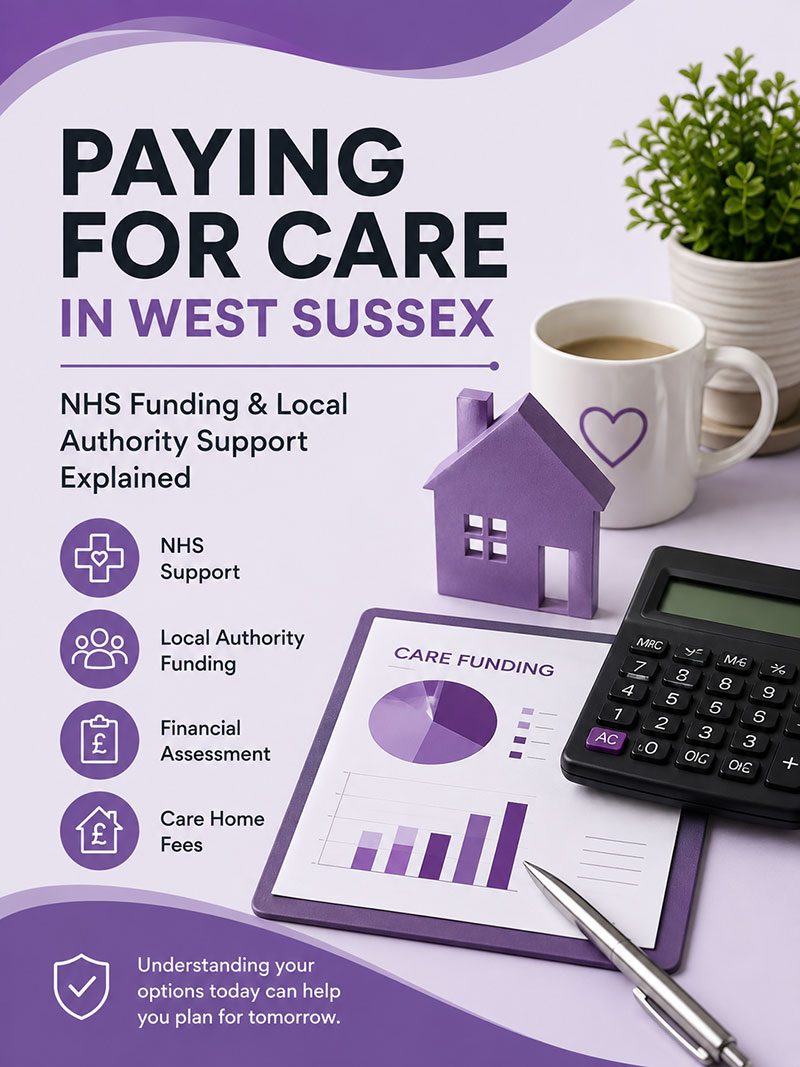
Care can potentially be funded in several different ways.
A person may pay privately, receive support from West Sussex County Council following appropriate assessments, qualify for NHS funding, or receive funding through a combination of different contributions.
Broadly, the main routes are:
Self-funding – where someone is responsible for meeting the cost of their own care, usually because their assessable capital is above the applicable local authority threshold.
Local authority care funding – which may be available where someone has eligible care and support needs and their financial circumstances meet the relevant means-tested criteria.
NHS funding – which operates differently because eligibility is based principally on assessed health and nursing needs rather than a person's wealth.
Two important forms of NHS support that families considering nursing home funding in West Sussex may encounter are NHS Continuing Healthcare (CHC) and NHS-funded Nursing Care (FNC).
West Sussex County Council states that a person who has been assessed as requiring residential or nursing care may be eligible for financial assistance, with their contribution determined through a financial assessment.
What Is NHS Continuing Healthcare (CHC)?
NHS Continuing Healthcare, usually abbreviated to NHS CHC, is a package of ongoing care arranged and funded solely by the NHS for adults who are assessed as having a primary health need.
Importantly, NHS Continuing Healthcare is not means-tested in the same way as local authority social care funding. Eligibility depends upon an assessment of the person's health and care needs rather than the value of their savings, income or property.
NHS guidance explains that adults must be assessed through the appropriate decision-making process to establish whether their needs amount to what is known as a primary health need.
This is particularly important when families ask:
Can the NHS Pay for Nursing Home Care?
Potentially, yes. If someone is assessed as eligible for NHS Continuing Healthcare, the NHS can fund their eligible package of care.
However, qualification is not automatic simply because somebody requires nursing care or has been diagnosed with a particular medical condition.
Who Qualifies for NHS Continuing Healthcare?
Eligibility for NHS Continuing Healthcare is based on the nature, intensity, complexity and unpredictability of a person's assessed needs and whether, taken together, those needs demonstrate a primary health need.
The assessment considers the person's overall requirements rather than focusing simply on their diagnosis, age, financial circumstances or the fact that they live in a nursing home.
This means that having dementia, Alzheimer's disease, Parkinson's disease, multiple sclerosis, a stroke-related disability or another long-term condition does not automatically result in NHS CHC eligibility.
Equally, someone should not assume that they will be ineligible simply because they own a property or have savings.
Financial circumstances are not the deciding factor for NHS Continuing Healthcare.
Families who believe CHC may be relevant should discuss the assessment process with the healthcare professionals involved in their relative's care or the appropriate NHS Integrated Care Board (ICB).
What Is NHS-Funded Nursing Care (FNC)?
NHS-funded Nursing Care, commonly known as FNC, is an NHS contribution towards the cost of registered nursing care for eligible people living in a care home that provides nursing.
It is different from NHS Continuing Healthcare.
Where someone does not qualify for full NHS Continuing Healthcare but has been assessed as needing care from a registered nurse within a nursing home, they may qualify for NHS-funded Nursing Care.
The NHS contribution relates specifically to nursing care provided by registered nurses. This can include direct nursing care as well as the planning, supervision and monitoring of nursing and healthcare tasks.
For 2026/27, the standard NHS-funded Nursing Care rate in England is £267.68 per week, effective from 1 April 2026. A higher rate of £368.24 per week continues to apply to certain people who were on the former higher band before 1 October 2007 and remain eligible.
These figures can change, so families researching nursing care funding should always check the current NHS guidance.
NHS Continuing Healthcare vs NHS-Funded Nursing Care: What's the Difference?
Although the names sound similar, NHS Continuing Healthcare and NHS-funded Nursing Care are not the same thing.
The simplest distinction is:
NHS Continuing Healthcare (CHC) is a complete package of eligible care funded solely by the NHS for an adult assessed as having a primary health need.
NHS-funded Nursing Care (FNC) is an NHS contribution towards registered nursing care for an eligible person living in a nursing home.
Therefore, receiving FNC does not mean that the NHS is necessarily paying the person's entire care-home bill.
Eligibility for either form of NHS support must be considered according to the individual's circumstances and assessed needs.
Can West Sussex County Council Help Pay for Care?
Potentially, yes.
West Sussex County Council may provide financial support towards eligible care costs following an assessment of the person's care and support needs and a separate assessment of their financial circumstances.
The first stage is establishing what care and support the individual requires. Where eligible needs are identified, the council can then consider the person's finances to establish whether financial assistance may be available and what contribution the individual may be expected to make.
For the 2026/27 financial year, the national upper capital limit in England remains £23,250, while the lower capital limit remains £14,250.
For permanent residential care, broadly:
. Above £23,250: a person will generally be responsible for funding their own care.
. Between £14,250 and £23,250: capital is taken into account through a tariff-income calculation alongside relevant income.
. At or below £14,250: capital at or below the lower limit is not used to calculate a tariff contribution, although relevant income may still contribute towards care costs.
Under the 2026/27 rules, tariff income between the lower and upper limits is calculated at £1 per week for every £250, or part of £250, of capital within that range.
These thresholds form part of the national charging framework. They should not be used to assume what an individual will personally pay because actual contributions depend upon the appropriate assessment.
How Does the Care Home Means Test Work?
A financial assessment, often referred to as a care home means test, looks at a person's financial resources to establish what they can reasonably afford to contribute towards eligible care and support.
West Sussex County Council explains that the assessment may consider financial resources such as savings, investments and relevant income. For permanent residential or nursing care, the value of property may also be considered depending upon the person's individual circumstances.
Different types of income and capital can be treated differently, and certain assets or circumstances may be disregarded.
This is why families should avoid trying to determine eligibility solely from a person's bank balance or one particular asset.
An individual financial assessment is necessary to establish how the relevant rules apply to that person.
Do You Have to Sell Your Home to Pay for Care?
No. Moving permanently into a care home does not automatically mean that a person's home must immediately be sold.
Whether a property is included within a financial assessment depends upon individual circumstances.
For example, West Sussex County Council states that the value of a home will not normally be included in its financial assessment where certain qualifying people continue to live there, which can include a partner, a child under 18 or a relative who is over 60 or disabled.
There may also be circumstances in which a Deferred Payment Agreement (DPA) can be considered.
A Deferred Payment Agreement can allow an eligible person to use the value tied up in their property to contribute towards care without having to sell the property immediately. It is effectively a loan secured against the property and is subject to eligibility requirements, charges and interest.
West Sussex County Council publishes specific information about its deferred payment arrangements, including eligibility and applicable charges.
Because the treatment of property can have significant financial and legal implications, families should obtain guidance based on their individual circumstances rather than assuming that a property must be sold or will automatically be disregarded.
What Happens When Savings Start to Run Out?
One of the most important considerations for someone who initially pays privately for care is planning ahead before their assessable capital approaches the local authority funding threshold.
Families should not necessarily wait until savings have already fallen below the applicable upper limit before seeking guidance.
West Sussex County Council advises people paying privately that they may become eligible for financial support when their savings and investments fall below the applicable threshold, subject to assessment.
However, reaching the threshold does not mean that the local authority automatically assumes responsibility for the entire cost of someone's care.
The person's care and support needs and financial circumstances may need to be assessed, and there can also be differences between the amount charged by a particular care provider and the amount a local authority is prepared to fund to meet someone's assessed eligible needs.
In some circumstances, where a chosen care home costs more than the local authority's applicable funding level, an additional contribution or third-party top-up may need to be considered.
Planning early gives families more time to understand these issues and explore the available options before financial circumstances become urgent.
Paying for Dementia or Nursing Care in West Sussex
Families sometimes assume that a diagnosis of dementia, Alzheimer's disease or another significant health condition automatically determines how someone's care will be funded.
That is not necessarily the case.
Two people with the same diagnosis can have very different care requirements.
One person living with dementia may primarily require support with everyday activities, personal care, reassurance and maintaining a safe routine. Another may have substantially more complex nursing or healthcare needs.
The appropriate funding route therefore depends upon the person's individual assessed needs and circumstances.
For NHS Continuing Healthcare, the central issue is whether the individual has a primary health need.
For NHS-funded Nursing Care, consideration includes whether registered nursing care is required within an appropriate nursing-home setting.
Local authority support, meanwhile, is means-tested and subject to both care needs and financial assessment.
Understanding these distinctions can help families ask better questions when investigating how to get help paying for care in West Sussex.
Choosing a Care Home in West Sussex
Understanding funding is important, but financial arrangements are only one part of choosing appropriate long-term care.
Families considering residential, dementia or nursing care should also look carefully at the individual's current requirements and how those requirements could potentially change over time.
Important considerations can include:
. The level and type of care available
. Nursing support where required
. Experience and continuity of the care team
. Dignity and personal choice
. Safety and wellbeing
. Communication with families
. Social engagement and activities
. Support for individual routines and preferences
. The physical environment
. Location and accessibility for family and friends
Where nursing care is required, families should understand how nursing needs are assessed, planned and managed.
Where someone is living with dementia, it can also be important to understand how the environment, care approach and everyday routines support familiarity, reassurance, dignity and individual needs.
Visiting a prospective home can be particularly valuable. It allows families to experience the environment themselves, meet members of the care team and ask questions about how their loved one's individual needs could be supported.
Homelands Nursing Home in Cowfold, West Sussex
For families exploring professional nursing and dementia care in West Sussex, Homelands Nursing Home is located on Horsham Road in Cowfold.
Homelands is part of Medicrest Group and provides residential elderly nursing and dementia care, including 24-hour nursing care, personalised care planning, dementia care, respite care, physical disability support, and palliative and end-of-life care.
Our approach at Homelands centres on understanding the individual.
We recognise that entering residential or nursing care represents a significant change not only for a resident but often for their entire family. Our aim is to create familiarity, continuity and trust while ensuring that care is planned around each resident's assessed needs.
Homelands comprises two neighbouring properties in the West Sussex countryside.
The Manor House supports elderly residents requiring nursing care, while The Coach House provides care for residents living with different forms and stages of dementia.
Homelands has a permanent team of registered nurses and carers and does not use agency staff. Nursing support includes supervised medication management and monitoring alongside support for residents with a range of long-term and progressive health conditions where their needs fall within the home's care capabilities.
Every prospective resident's circumstances are different. Before admission, understanding their individual needs and determining whether Homelands can safely and appropriately provide the required support is an important part of making an informed care decision.
Planning Ahead for Care in West Sussex
Questions surrounding care funding are often easier to manage when families investigate the available options before an urgent care decision has to be made.
If NHS Continuing Healthcare could potentially be relevant, families can ask the healthcare professionals involved in their relative's care about the appropriate assessment process.
If local authority assistance may be required, West Sussex County Council can provide information about its care needs and financial assessment processes.
Families paying privately may also benefit from appropriately qualified independent financial advice, particularly where property, pensions, savings, investments or longer-term care planning are involved.
Most importantly, care funding and choosing a care provider are connected but separate decisions.
Understanding the appropriate funding route is important, but so is finding a home capable of providing the right level of support, comfort, dignity and continuity for the individual.
Frequently Asked Questions About Paying for Care in West Sussex
Can the NHS Pay for Care Home Fees?
Yes, in some circumstances. If someone is assessed as eligible for NHS Continuing Healthcare, the NHS funds their eligible package of care. Eligibility is based on assessed health needs and whether the person has a primary health need rather than their financial circumstances.
Who Qualifies for NHS Continuing Healthcare?
There is no automatic qualification based upon a particular diagnosis. The NHS assessment process considers the person's overall needs and whether these demonstrate a primary health need.
Can West Sussex County Council Help Pay for a Care Home?
Potentially. Where someone has eligible care and support needs, West Sussex County Council can carry out a financial assessment to determine whether financial assistance may be available and what contribution the individual may be expected to make.
How Does the Care Home Means Test Work?
A financial assessment considers relevant income and capital to determine what someone can afford to contribute. Different assets and forms of income can be treated differently, so an individual's circumstances need to be assessed rather than eligibility being determined from savings alone.
Do You Have to Sell Your Home to Pay for Care?
Not automatically. Whether a property is included in a financial assessment depends upon individual circumstances. Property disregards can apply in certain situations, and eligible people may also be able to consider a Deferred Payment Agreement.
What Happens When Savings Start to Run Out?
If someone is self-funding, it is sensible to contact West Sussex County Council before their assessable capital approaches the applicable upper threshold. This allows time for care needs and financial circumstances to be assessed and potential future funding arrangements to be considered.
Speak to Homelands Nursing Home About Care in West Sussex
If you are considering nursing or dementia care for yourself or someone close to you, we understand there can be many questions to answer — from understanding the level of care required to navigating the practicalities of moving into a care home.
At Homelands Nursing Home in Cowfold, West Sussex, we welcome conversations with families who are beginning to explore their options.
We can discuss the care available at Homelands, learn more about your individual circumstances and help you understand whether our home may be appropriate for your needs.
Homelands Nursing Home
Horsham Road
Cowfold
West Sussex
RH13 8AJ
Telephone: 01403 864 581
Contact Homelands Nursing Home for a friendly conversation about nursing, dementia and elderly care in West Sussex and to learn more about the support available.
Funding rules, NHS contribution rates, financial thresholds and eligibility criteria may change. Information in this article reflects official guidance available in 2026 and should not be treated as personalised financial, legal or healthcare advice. Always check current guidance with the NHS, West Sussex County Council or an appropriately qualified independent adviser.
Explore our latest news & posts
















10 Most frequently asked questions – answered.
What are residents saying about us?
View feedback from each of our care homes.
We take pride in the kind words and positive reviews we receive from our residential care homes in Surrey and West Sussex. Your trust and appreciation serve as powerful reminders of why we do what we do.

We look forward to hearing from you.